December 22, 2010 – The FDIC closed on the sale of $279 million of assets from nine failed bank receiverships. The winning bidder of the asset pool was Cache Valley Bank, Logan, Utah, with a purchase price of 22.2% of the unpaid principal balance of $279 million. The failed bank assets will be placed into […]
FDIC Sells Failed Bank Assets For Pennies On The Dollar To Bank With Outstanding TARP Loans
December 22, 2010 By Leave a Comment
Six Problem Banks With $1.2 Billion In Assets Fail – Failed Banks For Year Total 157
December 18, 2010 By 2 Comments
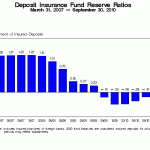
The number of failed banks reached 157 as regulators closed six banks in Florida, Georgia, Arkansas and Minnesota. The six failed banks this week had a total of $1.2 billion in assets and resulted in a loss to the FDIC Deposit Insurance Fund of $267.6 million. The total loss to the depleted FDIC Deposit Insurance […]
FDIC Projects Losses Of $50 Billion On Failed Banks – Insurance Fund To Remain Underfunded For Decades
December 15, 2010 By Leave a Comment
December 14, 2010 – The current banking crisis has completely depleted the FDIC’s Deposit Insurance Fund which currently has a negative balance of $8 billion. In an effort to rebuild the insurance fund that protects depositors from loss when banks fail, the FDIC Board approved a rule to set the designated reserve ratio (DRR) at […]
Banks May Be Facing A Tidal Wave Of Mortgage Defaults
December 14, 2010 By Leave a Comment
Although bank stocks have rallied recently, it may be premature to expect a recovery for the banking industry. There are multiple indicators that a housing recovery is little more than a distant dream and current trends suggest that mortgage defaults may increase substantially. With banks currently holding approximately $3 trillion dollars in residential mortgages, […]
FDIC Issues October Enforcement Actions On Problem Banks
November 28, 2010 By 3 Comments
November, 2010 – The FDIC recently released a list of orders of administrative enforcement actions taken against banks in October, including 1 cease and desist order, 16 consent orders (formerly called “cease and desist consent orders”), 18 civil money penalties and 1 Prompt Corrective Action. Formal enforcement actions are publicly disclosed by regulators and used […]
FDIC Problem Bank List Increases Again To Highest Level Since 1993
November 23, 2010 By Leave a Comment
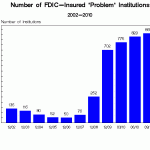
November 23, 2010 – The third quarter 2010 FDIC Quarterly Banking Profile showed an increase in the number of Problem Banks from 829 to 860. The number of banks on the Problem Bank List now represents 11% of all FDIC insured institutions. Total assets of Problem Banks decreased slightly from $403 billion to $379 billion […]
FDIC Sells Failed Allegiance Bank of North America To Bank With Outstanding TARP Loan
November 19, 2010 By 1 Comment
Allegiance Bank of North America, Bala Cynwyd, Pennsylvania, was closed today by the Secretary of the Pennsylvania Department of Banking, which appointed the FDIC as receiver. The FDIC entered into a purchase and assumption agreement with VIST Bank, Wyomissing, PA, to assume all deposits and purchase all assets of failed Allegiance. Allegiance was a state-chartered […]
Fed Puts Bank Dividend Payments On Hold Until Capital Adequacy Tested
November 18, 2010 By Leave a Comment
November 17, 2010 – As anticipated, the Federal Reserve Board issued guidelines to the nation’s largest bank holding companies (BHCs) for evaluating plans to pay stock dividends or repurchase common stock. The Fed stated that the guidelines are a conservative approach to “ensure that the BHCs hold adequate capital to maintain ready access to funding, […]
Tougher Standards By Banks For Mortgage Approval Requires Credit Education
November 18, 2010 By Leave a Comment
November 18, 2010 – Several years ago, the mortgage underwriting standards of banks were so liberal that nearly anyone could get an approval, regardless of income levels or credit scores. The subsequent real estate crash and huge number of mortgage defaults since those easy lending days has resulted in much tougher underwriting standards. Many borrowers […]
Warren Buffett Bullish On Wells Fargo – Stock Price Unchanged For 10 Years
November 16, 2010 By 1 Comment
If you want to invest in bank stocks, legendary Warren Buffett says buy Wells Fargo. Wells Fargo, the fourth largest bank holding company in the United States with $1.22 trillion dollars in assets emerged from the financial crisis in far better shape than many of its large competitors. The management team at Wells avoided high […]