Why The Biggest Banks Are Too Big To Fail
The “too big to fail bank” issue has been debated ever since the financial meltdown of 2008 brought many of the mega banks to the brink of financial collapse. The government’s recent moves to strengthen its financial regulatory powers over financial institutions has brought to center stage the issues of whether bank size should be limited and exactly what mechanisms should be put into place to deal with the potential failure of a mega bank.
Although the FDIC currently insures deposits at 8,195 banks and savings associations, 8,175 of those institutions are almost irrelevant since the top 20 banks have 70% of the entire banking system’s assets. Even more astonishing is the huge concentration of assets at the “Top Five Mega Banks”. The most recent FDIC Depository Report as of June 30, 2009 shows a total of $13.3 trillion dollars in assets held by the 8,195 FDIC insured institutions. The Top Five Mega Bank’s total assets of $8.29 trillion represent a staggering 62.3% of total banking industry assets.
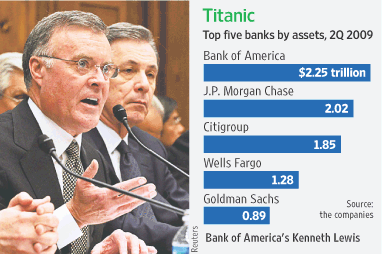
The "Mega Banks", courtesy WSJ
The failure of any one of the Mega Banks would be a systemic threat to the overall financial system and cause widespread public panic. The government would, therefore, be forced to take whatever steps were necessary to avoid the risk of a financial meltdown caused by the failure of a mega bank. The largest banks have officially become “too big to fail” and everyone knows it. Given the de facto “too big to fail” policy, how do regulators deal with this huge concentration of risk and the potential failure of a “too big to fail” institution?
Policy Solutions To The Risks Of “Too Big To Fail”
FDIC Chairman Sheila Bair has addressed the too big to fail issue in depth as previously discussed – see Bair Says Banks Not Viable Should Fail and Bair Comments On Banks Too Big To Fail.
Sheila Bair’s comments: “Of primary importance is addressing too big to fail. Market participants should understand that large institutions can and will fail and that an effective resolution mechanism will be uniformly applied to institutions in a fair, transparent and consistent manner. It is also important that we maintain a focus on assuring strong capital requirements for banks and their holding companies.”
On July 23, 2009, Sheila Bair set forth guidelines to deal with the failure of a large financial institution.
In a properly functioning market economy there will be winners and losers, and when firms — through their own mismanagement and excessive risk taking – are no longer viable, they should fail. Actions that prevent firms from failing ultimately distort market mechanisms, including the market’s incentive to monitor the actions of similarly situated firms. Unfortunately, the actions taken during the past year have reinforced the idea that some financial organizations are too big to fail.
The notion of too big to fail creates a vicious circle that needs to be broken. Large firms are able to raise huge amounts of debt and equity and are given access to the credit markets at favorable terms without consideration of the firms’ risk profile. Investors and creditors believe their exposure is minimal since they also believe the government will not allow these firms to fail.
Given this, we need to develop a resolution regime that provides for the orderly wind-down of large, systemically important financial firms, without imposing large costs to the taxpayers.
Even if risk-management practices improve dramatically and we introduce effective macro-prudential supervision, the odds are that a large systemically significant firm will become troubled or fail at some time in the future. The current crisis has clearly demonstrated the need for a single resolution mechanism for financial firms that will preserve stability while imposing the losses on shareholders and creditors and replacing senior management to encourage market discipline.
Regulatory Malpractice?
Thomas Hoenig, the president of the Kansas City Federal Reserve Bank has also expressed criticisms and possible policy solutions to the current “to big to fail” policy. Consider Fighting To Rein In Big Banks’ Power.
In June Hoenig stirred up controversy when he accused the federal government of “regulatory malpractice” by creating another regulatory regime without addressing “too big to fail.” He warned of an “oligarchy of interest that will fail to serve the best interests of business, the consumer and the U.S. economy.”
Hoenig has resumed his campaign in op-ed articles in major newspapers. His main point: Talk about the prudent supervision of banks is putting the cart before the horse; standing in the way of real reform is failure to find a means of systematically dealing with the too-big-to-fail policy.
The phrase describes the special status apparently conferred on America’s biggest banks, which have received billions in taxpayer bailouts and guarantees in the name of keeping the financial system working. The federal government through bailouts has placed them beyond the normal penalties for failure — receivership, bankruptcy and disgrace. These big banks also happen to be among the largest contributors to both political parties.
To Hoenig, they represent the new aristocracy of U.S. commerce. For months the Kansas City Fed chief has called for policymakers to create a plan to break up the most insolvent of these institutions, putting them first into receivership. “If we hesitate to make needed changes,” he says, “we will perpetuate an oligarchy of interest.”
The concentration of power among a few mega-banks troubles Hoenig. “I’ve seen banks close for making mistakes,” says Hoenig. “I’ve seen other banks too big for the regulators, being supported by the U.S. taxpayer. It’s harmful to the infrastructure, and sends the wrong message, that influence is what really matters. If we fail to address ‘too big to-fail,’ it will only get worse.”
In fact, argues Hoenig, the Fed has been behind the process of creating the giants that today tower over the financial industry. “Because of too-big-to-fail, the Fed has encouraged merging sick banks into larger ones, a process that tends to concentrate risk.”
Does the mere existence of mega banks create systemic financial risks? Some would argue that with proper regulation and the imposition of very strong capital requirements, systemic risks would be reduced by allowing mega banks, since it would be easier to regulate and conduct proper oversight of a small number of large banks.
What Role Should The Fed Play In Regulatory Reform?
There are many critics of the proposal to make the Federal Reserve the primary regulatory to assess systemic risk. Consider The Fed Can’t Monitor Systemic Risk.
The problem is the Fed itself can create systemic risk. Many scholars, for example, have argued that by keeping interest rates too low for too long the Fed created the housing bubble that gave us the current mortgage meltdown, financial crisis and recession.
All of this means just one thing: If we are to have a mechanism to prevent systemic risk it should be independent of the Fed. That is probably one reason why creating a systemic-risk council made up of all of the federal government’s financial regulatory agencies, including the Fed, has the support of Senate Banking Committee Chairman Christ Dodd (D., Conn.) and others on the committee.
But piling yet more responsibilities on the Fed raises the question of whether we are serious about discovering incipient systemic risk. If we are, then an agency outside of the Fed should be tasked with that responsibility. Tasking the Fed with that responsibility would bury it among many other inconsistent roles and give the agency incentives to ignore warning signals that an independent body would be likely to spot.
“Too Big To Fail” Dilemma Needs Solution
The banking system is dominated by a small number of mega banks. The inherent risks associated with such an extreme concentration of assets cannot be ignored by regulators. The hard part will be arriving at and implementing a solution so that the financial meltdown of 2008 will not be repeated.
More on this topic from The Big Picture:
Just found your site and have subscribed for updates. The articles I have read so far are clear, concise and speak to the issues the main stream media has not addressed.
Thank you for providing this service.
Ragna
The FDIC is fraudulent! When Glass-Steagall Act was repealed it was necessary that FDIC be revoked!! The public would have been notified of the reasons for the act and consequences it was meant to prevent!!! The necessary action to revoke FDIC was purposely and deceptively withheld from public notice!!!
With the passage of the Glass-Steagall Act in 1933, after the 1929 stock market crash, commercial and investment banking were separated, and the FDIC was founded with an understanding that it could underwrite (insure) the commercial deposits because those funds were not being used for speculation!! When the Glass-Steagall Act was repealed in 1996 Gramm- Leachy-Bliley Act (money weight-leech-pirate act), investment banking was provided access to commercial deposits. FDIC underwriting specifically prohibits use of commercial deposits for financial investment assets and is not obligated to cover the losses!!!
Further, if one had placed their commercial deposits in financial risk markets, the rate of interest on returns would have been appreciably greater than the trivial commercial deposit rates received during the time of the market expansion. In addition, control and leverage for the commercial deposits would have provided risk manageability. Investment institutions deceptively usurped FDIC restrictions, which allowed the banks to profit illegally and profoundly, but also allowed the banks to destroy the US and global economic systems. The US government and taxpayer is therefore entitled to seek liabilities and damages against the financial institutions.
Thus, not only should FDIC not pay out those funds to force the issue, the politicians who purposely and deceptively failed to revoke FDIC, with the implementation of the Gramm-Leachy-Bliley- Act, should be prosecuted and impeached for malfeasance!!! The assets for the financial institutions, which corroborated to assist in the espionage and financial terrorism, should be seized and incarcerated as individuals; their responsible persons should be prosecuted, and their institutions fined to pay for the damages.
In 1929 a special district attorney was assigned to investigate the crash and many were prosecuted!!! 70 years later such prosecutions are a ridiculous joke!!! The US citizens can convene a grand jury!!! The US citizens do not need the permission of government to prosecute these criminals under a grand jury!!! Appoint a presiding lawyer!!! Convene a grand jury!!! Prosecute the government officials if they get in the way!!!!!!!!!!!!!!!!!!
http://www.debatepolitics.com/blogs/monk-eye/179-call-all-support-impeachments-and-class-action-lawsuits.html
The FDIC and Fed failed to enforce Prompt Corrective Action which existed since 1992 in the regulatory framework from legislation passed in 1991, called the Federal Deposit Insurance Corporation Improvement Act.
This is skullduggery that deserves more than only public exposure. My contention is that domestic and european/multilateral and 1% influenced political forces channeled in part through the Fed, interfered with the FDIC from enforcing PCA.
Meanwhile the largest banks aren’t examined and haven’t been for years. Although these banks supply their stress tests and capital ‘restoration’ plans, research shows that examined banks’ CAMELS ratings better reflect what the CAMELS rating says of the banks, than the CAMELS ratings of banks not examined. That’s damning.
I don’t think the FDIC likes not being able to examine the big banks and actually the FDIC had power to lance that problem without Dodd Frank and FSOC, however the Fed as a political creature was the selected player to run pass interference against enforcing PCA and was a facilitator in interfering the FDIC from enforcing PCA.
In the past as the TooBigToFails’ were examined and although they were abusers of power, it’s now a more complex problem because of international politics we’ve got with multilateral agreements such as the G20 Transatlantic Agreements.
These call for the US to de-industrialize and meanwhile the nature of the globalism has our banks using ANY means to ‘bulk’ up to the sizes of the european ‘national champions’ and the japanese banks. Size isn’t indicative of better quality or more power but in the oldworld those financial institutions enjoy being roughly the financial arms of the large corporates and those european and other foreign governments.
Ours werent to be quite like that. We’d had a reasonably functioning regulatory framework, whereas in asia and the Old world, there’s little regulatory framework and effective oversight against the abuse that the TooBigToFails can bring to us and themselves enjoy to suit their self interests.
It’s not that they’re too big, it’s that regardless of their size, they’ve been able to abuse power.It’s THIS that we need to solve. This doesn’t come from hiving apart bigFinancial institutions or the Fed stopping QE and suddenly there’s a market correction like 2008 and ISDA cartel banks’ balance sheets contract in the fair valuing to correcting financial markets.
Abuse of power is solved by enforcing the previously existing regulatory framework. That’s not basel which we didn’t need in I, II or III. In Basel II which our ISDA and largest banks use, they file only capital plans and stress tests. We’d had the robust regulatory framework that had functioned and required more accountability of our largest financial institutions. Legislators made to believe that we’d needed to have our banks comply at all with foreign banking ‘regulatory’ confusion, dressed up and served up to us as if that that is regulation we needed and as if ours was inferior, but foisted on us and expected then and now in version III to be embraced by way of the multilateralism.
The germans are a driver in the flawed multilateralism, although they’re hating the capital adequacy framework in basel III which we’ve had for decades in our regulatory framework. The CAMELS rating has the “C” for capital; virtually no other country around the world had capital adequacy except perhaps the Swiss. I think only the US has a Deposit Insurance Fund and a framework that required our banks to function as arteries for the commercial and financial system of the private and public sector, but are private sector enterprises that have to answer to partners, or shareholders, or regulators and and the voters, and indirectly small and large creditors such as depositors and lending counterparties. In the Old world there isn’t this accountability to this degree.
See? You have to understand what you’re seeing and be onto the slick schemes in this long time, commercial and economic war tactic from the old world. BIS anyway had been a german/early 3rd reich or weimar construct. What we need to do is ask ourselves why do we need what is proposed on us by a foreign body not subject to the US voters, Congress and pretends we’ve lacked an effective regulatory framework, when close study shows basel II was a form of deregulation and basel I was bad for commercial and industrial lending but German banks ignored basel I and II in order to buy and/or lend into to control whatever and where ever they could.
We’d never needed to risk weight our commercial and industrial loans. Our credit committees in the banks and the FDIC and other regulators examined and established guidelines for the banks; they’d followed. IF all of these participants lurched away from what were the rules and appropriate business conduct, we’d not need Basel to restore what we’ve got. We’ve got regulation we failed to keep and enforce. Basel can’t and will not solve THAT. We’d had better than what basel proposes and basel II anyway again served management’s purposes to shed examination and accountability for expedience and to serve the purposes of the Oldworld banks, favoring the Germans over any other.
Now the problem is the ISDA banks plumed their balance sheets with OTC contracts and since 2000 have been enabled to trade these ad hoc contracts. In terms of resembling performing bank loans or underwriting of ‘cash’ securities, otc contract and derivatives writing and trading don’t resemble ordinary commercial banking business. Actually OTC contracts and trading of these and writing and trading derivatives is UNSAFE and UNSOUND banking practices of which by the regulators should have been ceased and desisted at the banks.
There were experts and other regulators that exposed the harm of writing and trading OTC contracts and derivatives, which were used to skirt the exchanges regulation of commodity contracts and other legitimate financial contracts traded over the exchanges which if you don’t handle the commodity contracts properly, you will get a delivery of bushels of corn or barrels of crude oil.
That business was a well worn groove, but the ISDA banks writing and trading derivatives have little more that snared their balance sheets in the problems of marginal business, OTC contracts written and traded to inflate the balance sheet and goose the income statement with trading fees and fair value created unrealized, non-cash gains, and make a gravy train by way of knowing what of those contracts they can write and given the Quantitative easing and/or market levels, have some idea on their comp that flows through the income statement by way of fair valuing the balance sheets kept afloat by Quantitative easing and/or inflated markets.
Again,we’re not talking about engaging in healthy banking business. These OTC contracts and derivatives are a sly and virtual forms of contructive fraud and fraudulent conveyance and an easy excuse to take the rules and the power to craft the comp scheme to a practice what’s seriously dysfunctional.
I don’t support DFA Titles I and II, however when the revenue model in the financial sector at the ISDA cartel punishes lending and making healthy loans into our economy, skirts our commodities markets and exchanges to suit self interests and disdains lines of business or avoids or thwarts lines of business that produce quality and sufficient operating cash flow, we’re looking at something sick inside the corpus.
Worse is that ISDA agreements de facto protect the abuse of the OTC contracting and trading; European banks any way were protected by their governments, and thus we see the ‘government backstop’ which the US enjoyed in the TooBigtofail and/or merging TooBigTofail into competitors. In effect, the ISDA agreements onto which the sovereigns have supported, enables the ISDA cartel members to self destruct, to blow up themselves and their sovereigns will provide back stop. And the Europeans have barely begun talks about dealing with TooBigToFail.
We ‘ve needed to stick to our own knitting. We’ve needed to stop comparing ourselves to the European practices and ways. We’ve needed to stop their influence on us and stop importing they’re corruption in effect we’ve embraced and stop allowing ourselves to be emfatuated with their appearances of sophistication when it’s really their calculus to get turf from and with us, deleterious to our own self interests and health playing into our ambitions to spread globally when that wasn’t the model in which the US was established.
And somewhat successfully they’ve (the Oldworld) has played us for fools and fanned that self destructive seed within our own corporate form. This has not been a good thing for the voters since the 1880s when achieving 14th Amendment protection from the Supreme Court. Or achieving the National Banking Act in 1863. Put together these ingredients and you better understand the roots of the problem. If the financial system is ‘crashed’, it’s done by pawns for players using the TooBigTofails partly as the way to pull of that sort of exacerbation of the crisis.
If we’re near the financial system in trauma, players know what’s going on at the TooBigtofails and so do the regulators, which have a mercenary characteristic now that’s more bare than in times past and all together producing a soup that doesn’t have to be a festering, last supper.
Like any knot it can be reversed, and unwind can occur and without the hits to capital.
The ISDA cartel take the law into their own hands. These also are the ‘toobigtofail’. Again it’s not their size, it’s their ability to abuse power, operate around and beyond the law and take it into their own hands and lobby for what suits their self interests, or those of the 1% and foreign royals which have bizarre and capricious aims which are contrary to our finanical system. Management have golden parachutes however, and thus are immunized from these hidden agendas that serve interests of buyers’ looking for toobigtofail at the expese of the US voters and our financial system and our commercial framework.