FDIC Quarterly Banking Profile 3/31/2009
The FDIC latest Quarterly Banking Profile, released today for the quarter ending March 31, 2009, showed another increase in the number of problem banks and a further large decrease in the FDIC Deposit Insurance Fund (DIF). As of the latest quarter, the number of problem banks increased to 305 with $220 billion in assets, up from the year end 2008 quarterly numbers of 252 problem banks with $159 billion in assets.
The increase of problem banks on an annual basis is probably more indicative of the poor health of the US banking industry than the quarterly increase. The number of problem banks increased from the year ago quarter by a stunning 239% (90 to 305) and the assets of problem banks increased by a huge 746% ($26 billion to $220 billion).
The graphical representation on problem assets and problem banks follows, courtesy of the FDIC.
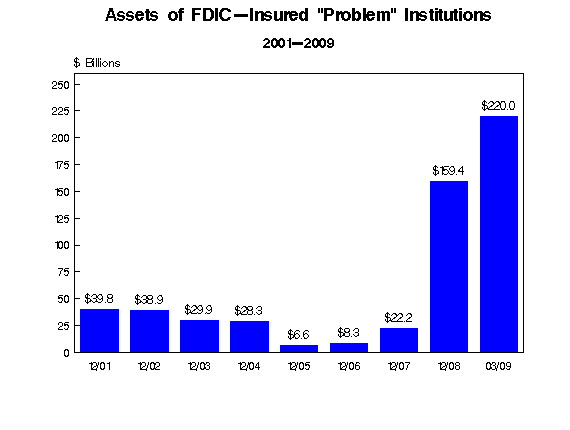
Assets of Problem Banks
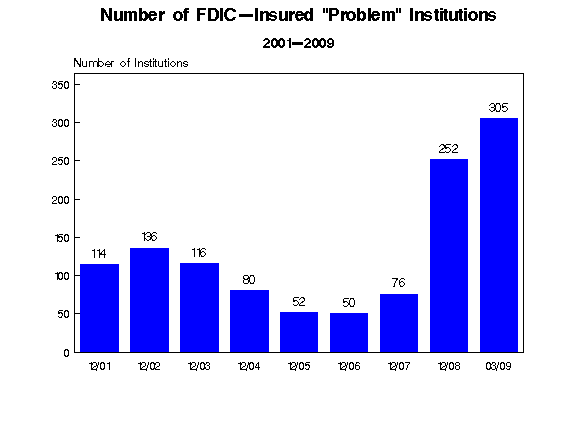
Number of FDIC Problem
Deposit Insurance Fund Nearly Exhausted
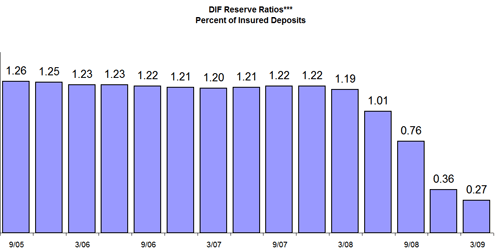
DIF Ratio - Percent of Insured Deposits
The FDIC has previously acknowledged that a very low DIF had the potential to cause concern among banking depositors.
The FDIC believes that it is important that the fund not decline to a level that could undermine public confidence in federal deposit insurance. A fund balance and reserve ratio that are near zero or negative could create public confusion about the FDIC’s ability to move quickly to resolve problem institutions and protect insured depositors.
As of March 31, 2009, the DIF has fallen to the lowest level since March 1993. During the first quarter 2009, the DIF decreased by 25% to only $13 billion. Of the 8,246 FDIC insured banks, the DIF fund now provides protection for a total of $4.8 trillion in deposits. One large banking failure could deplete the entire FDIC insurance fund.
DIF Worse Than It Seems
The FDIC report on the latest DIF reserve ratio is computed based on the old $100,000 deposit coverage limit. Since the FDIC recently raised the deposit coverage limit to $250,000, the actual DIF ratio is probably at an all time low. The total deposits of the 8,246 FDIC insured banks total $8.9 trillion meaning that the amount of FDIC insured deposits is certainly far larger than the $4.8 trillion reported by the FDIC, based on the increased deposit coverage limits.
FDIC losses on previous banking failures of 2009 often amounted to as much as 30% of the failed institution’s deposits. If we apply a more conservative 25% loss ratio on the reported $220 billion of assets held by problem banks, the loss to the DIF fund could amount to $55 billion which would leave the DIF with a large deficit of $42 billion. Of course, not all of the problem banks will fail, but many banks not on the problem banking list will probably fail as well – see Expert Predicts Up To 500 Banking Failures in 2009.
The FDIC has acknowledged that the DIF will probably be wiped out entirely and put into a negative balance during 2009. The FDIC has already taken the necessary steps to protect depositor funds when the DIF is wiped out. Congress has approved an increase in the FDIC line of credit with the Treasury of up to $500 billion and the FDIC has imposed a special assessment of 5 basis points on the banking industry’s insured deposits to help replenish the DIF. Given the actions taken by the FDIC, depositors at this point should not have undue concerns about the safety of their deposits up to the insured limits.
All money is created through banks through fractional reserve banking. Governments Borrow money when they increase their money supply and when they do this the banks around the world have no problem lending (directly or indirectly) because they only have to have 10% reserves. The governments pay back with Interest the money the banks created out of thin air.
The tax payer’s savings gets looted through inflation and then the banks get the interest from the government taxes.
People mistakenly think the government creates money this is an outright Lie. Governments are supposed to create debt free money without interest that the people use but that is not how it works today. Under Pres. Lincoln this is how it worked, today we are slaves to the banks and their fractional reserve banking scam and until people wake up to this scam nothing is going to change.
If you doubt me, then where did the trillions of dollars come from? It didn’t exist 100 years ago. You will then say the government created it but that is not true, they Borrowed it. Then you will ask, how can they borrow trillions of dollars that don’t exist and then you have just figured out the scam. Fix the broken system and you will solve all these problems. Money is being created that doesn’t exist and someone is getting rich off of this scam!
The scam is exposed when people can’t pay back their loans and the banks do not have enough reserves to cover what they show they are supposed to have. This is where we are in the scam, they have been caught. This should be the end of the scam but instead we are putting the tax payer on the hook again to bailout their scam. It will not work because it is a broken system based on fraud.
The next step in the scam is global currency; don’t let them get away with this because it is the same scam just global. Under the new global scam government(s) will never be able to correct the problem with debt free money creation and you will have global tyranny as described in the end times prophecy in the Bible.