Problem Bank List Tracking Problem Banks and Failed Banks 2012-05-20T22:31:32Z http://problembanklist.com/feed/atom/ WordPress Problem Bank List Staff http:// <![CDATA[Alabama Trust Bank, N.A., Sylacauga, Alabama, Closed By Regulators]]> http://problembanklist.com/?p=4856 2012-05-19T01:59:53Z 2012-05-19T01:59:53Z Alabama Trust Bank, National Association, Sylacauga, Alabama, was closed today by the Office of the Comptroller of the Currency.  The FDIC, appointed as receiver, sold the failed bank to Southern States Bank, Anniston, Alabama, which assumed all deposits of Alabama Trust Bank.

Alabama Trust Bank, established in April 2000, was a small one branch bank with only $51.6 million in assets and less than 30 employees. The bank grew rapidly during the lending boom years of the 2000′s growing from only $10 million in assets in 2000 to over $110 million by early 2008.

Alabama Trust ran into trouble with an accelerating amount of loan defaults and by the of 2011, the Bank had a troubled asset ratio of almost 200%.  Once the level of troubled loans exceeds 100%, bank failure is almost inevitable.

Courtesy: banktracker.investigativereportingworkshop.org

In December 2010, Alabama Trust Bank signed a Consent Order with the Comptroller of the Currency agreeing to institute measures to cure operating and financial deficiencies cited in the Consent Order.  The Bank was unable to recover financially and the amount of loan defaults increased rapidly during 2011 which ultimately lead to the Bank’s failure.

Alabama Trust will reopen on Saturday as a branch of Southern States Bank and all depositors of Alabama Trust will automatically become depositors of Southern States Bank.  Over the weekend, depositors of Alabama Trust will have access to their money through the use of debit cards, checks and ATMs.

Southern States Bank agreed to purchase all of the assets of Alabama Trust.  As of March 31, 2012, Alabama Trust had total deposits of $45.1 million and total assets of $51.6 million.  Southern States Bank, established in August 2007, is profitable and has over $200 million in total assets.  Today’s acquisition of Alabama Trust was the first purchase of a failed bank by Southern States.

The cost to the FDIC Deposit Insurance Fund for the failure of Alabama Trust is $8.9 million.  Alabama Trust becomes the 24th banking failure of 2012 and the first in Alabama.

]]>
0
Problem Bank List Staff http:// <![CDATA[Banks Amass $211 Trillion In Derivatives, JP Morgan Loses $2 Billion And Volcher Rule Debates Continue]]> http://problembanklist.com/?p=4838 2012-05-11T10:31:20Z 2012-05-11T10:11:03Z The goal of the Volcker Rule, which became law under the Dodd-Frank Act was to restrict speculative trading activity in risky derivatives by the Too Big To Fail Banks.  The ban on proprietary bank trading was proposed by former Federal Reserve Chairman Paul Volcker who believed that one of the primary causes of the 2008 financial meltdown was a result of speculative trading activity by banks.

Volcker argued that the use of depositor money back by FDIC deposit insurance to engage in risky speculation created systemic risk to the U.S. financial system.  In addition, Volcker said that banks holding massive positions in derivatives to allegedly control risk were, in fact, creating even greater risk to the financial system.

Under the Dodd-Frank Act, the Volcker Rule’s provisions were scheduled to be implemented by July 21, 2012.  During the two years since the Volcker Rule became law, regulators, bankers, legislators and lobbyists have been in a non stop battle over how the rule should be implemented and can’t even agree on what date the Volcker Rule regulations should become effective.

Meanwhile, the biggest banks in the country have built up massive speculative positions in derivatives.  The Too Big To Fail Banks, by engaging in activities more suited to hedge funds and casinos, have added an element of instability and risk to the financial system that was supposed to be eliminated by the Volcker Rule.

Evidence of the fact that the Too Big To Fail Banks have not taken the Volcker Rule seriously can be seen in the latest numbers published by the FDIC.  As of December 31, 2011, the 7 largest banks in the country held an astonishing $211.2 trillion in derivative contracts.  By way of comparison, the entire gross domestic product of the United States is only about $15 trillion.

Source: FDIC

The composition of the $211.2 trillion of derivatives is primarily related to bets on interest rates.


Another reminder of the huge risks that banks are taking by making risky trades with FDIC insured deposits was the announcement by JP Morgan that $2 billion dollars was lost on speculative trading bets.

JP Morgan Chief Executive Officer Jamie Dimon said the firm suffered a $2 billion trading loss after an “egregious” failure in a unit managing risks, jeopardizing Wall Street banks’ efforts to loosen a federal ban on bets with their own money.

The firm’s chief investment office, run by Ina Drew, 55, took flawed positions on synthetic credit securities that remain volatile and may cost an additional $1 billion this quarter or next, Dimon told analysts yesterday. Losses mounted as JPMorgan tried to mitigate transactions designed to hedge credit exposure.

“There were many errors, sloppiness and bad judgment,” Dimon said as the company’s stock fell in extended trading. “These were grievous mistakes, they were self-inflicted.”

The chief investment office was thrust into the debate over U.S. efforts to ban proprietary trading when Bloomberg News reported last month that the unit had taken bets so big that JPMorgan, the largest and most profitable U.S. bank, probably couldn’t unwind them without losing money or roiling financial markets. Dimon, 56, had transformed the unit in recent years to make bigger and riskier speculative trades with the bank’s money, five former employees said.

Dimon had defended the unit as a “sophisticated” guardian of the bank’s funds on an April 13 conference call, calling news coverage “a complete tempest in a teapot.” On May 2, he led fellow Wall Street CEOs in a closed-door meeting to lobby the Federal Reserve about softening proposed U.S. reforms that might crimp their profits.

‘Egg on His Face’

Yesterday, he said the timing of the trading blunders “plays right into the hands of a bunch of pundits out there” who are pushing for a strict version of the proprietary trading ban named for former Federal Reserve Chairman Paul Volcker.

“It’s a major event that confirms a lot of investors’ worst fears about bank risk,” said Frank Partnoy, a former derivatives trader who’s now a law and finance professor at the University of San Diego. Concern is “that at a large, supposedly sophisticated institution, even something called a ‘hedge’ can contain all kinds of hidden risks that the senior people don’t understand.”

It is painfully obvious that the thousands of pages of laws and regulations of the Dodd-Frank Act have done little to reduce the size, complexity or systemic risk of the Too Big To Fail Banks.

]]>
0
Problem Bank List Staff http:// <![CDATA[Security Bank, North Lauderdale, FL, Closed By Regulators]]> http://problembanklist.com/?p=4829 2012-05-05T00:28:47Z 2012-05-05T00:28:47Z Security Bank, National Association, North Lauderdale, FL was closed by the Office of the Comptroller of the Currency.  The FDIC, appointed as receiver, sold the failed bank to Banesco USA of Coral Gables, Florida.  Under the purchase and assumption agreement between Banesco and the FDIC, all deposits of failed Security Bank will be assumed by Banesco.

Security Bank

Security Bank, established in 1980, was a relatively small bank with only three branches and $101 million in assets as of March 31, 2012.  Poor lending decisions and collapsing real estate values in South Florida resulted in continuing losses that ultimately resulted in the Bank’s failure.

Security Bank lost money in every quarter since December 31, 2008 and the Bank was under increased regulatory scrutiny since May 2010 when the Bank signed a consent order with the Office of the Comptroller of the Currency.  The holding company for Security Bank is Faro Bancorp, Inc. of Miami.

All three branches of Security Bank will reopen on Monday as branches of Banesco USA and all depositors of Security Bank will automatically become depositors of Banesco with uninterrupted FDIC deposit insurance coverage.  Over the weekend, depositors of Security Bank will continue to have access to their money through the use of debit cards, ATMs and checking accounts.

Security Bank had total assets of $101.0 million and total deposits of $99.1 million at March 31, 2012.  Banesco USA agreed to purchase all of the assets of Security Bank.  The FDIC did not enter into a loss-share agreement with Banesco but did agree to sell the assets at a discount of $17.9 million.

Banesco USA is a fast growing and profitable South Florida bank with over $500 million in assets.

The cost to the FDIC deposit insurance fund for the failure of Security Bank is $10.8 million.  Security Bank becomes the nation’s 23rd banking failure of the year and the third in Florida.

]]>
0
Problem Bank List Staff http:// <![CDATA[Dallas Fed Says “Too Big To Fail Banks” Should Be Broken Up – Future “Severe Crises” Possible]]> http://problembanklist.com/?p=4816 2012-05-03T09:21:02Z 2012-05-03T09:21:02Z The Federal Reserve Bank of Dallas joined the growing chorus of critics who maintain that the Dodd-Frank Act will not prevent future taxpayer funded bank bailouts.  The Dallas Fed said taxpayers are still at risk for the cost of large banks failures and that any future bailouts should result in severe consequences for both bank management and bank creditors.  According to Bloomberg,

The Federal Reserve Bank of Dallas said taxpayer aid to failing banks should come only after the voiding of all employment and bonus contracts and the removal of chief executive officers and boards of directors.

“A set of harsh, non-negotiable consequences” for requesting U.S. Treasury assistance might also include “clawbacks” to gain cash and stock bonuses paid the top management team during the prior two years, the Dallas Fed said today in a slide presentation on its website.

The proposal reflects Dallas Fed President Richard Fisher’s view that large U.S. banks need to be split apart because they operate with an implied government safety net that puts their risks of failure on taxpayers.

The “institutions that amplified and prolonged the recent financial crisis remain a hindrance to full economic recovery and to the very ideal of American capitalism,” Fisher said in an essay in the Dallas Fed’s 2011 annual report posted online.

The Federal Reserve Bank of Dallas contends that if the implicit government guarantee to save the big banks undermines market discipline, the result could be severe financial crises.  Selected pages from the Dallas Fed’s presentation entitled “Choosing the Road to Prosperity: Why We Must End Too Big To Fail – Now”, are shown below.

The presentation is a sober reminder of how close the financial system came to total collapse in 2008 and why we remain at risk for a potentially worse future crisis.

]]>
0
Problem Bank List Staff http:// <![CDATA[Five Banks Collapse In Four States – 2012 Bank Failures Total 22 – Are Your Deposits Insured?]]> http://problembanklist.com/?p=4803 2012-04-28T05:45:19Z 2012-04-28T05:44:42Z Regulators got back to work during the last week of April, closing five banks in four different states.  A total of 22 banks have failed this year compared to a total of 92 bank failures during 2011.  If the rate of bank failures for the first four months of the year is annualized, total bank closings during 2012 should approach 70.

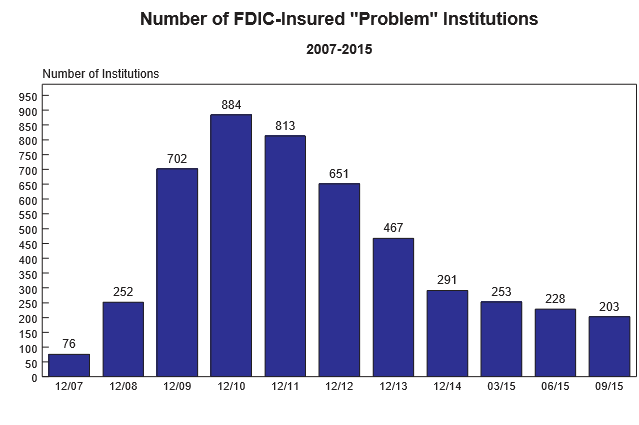
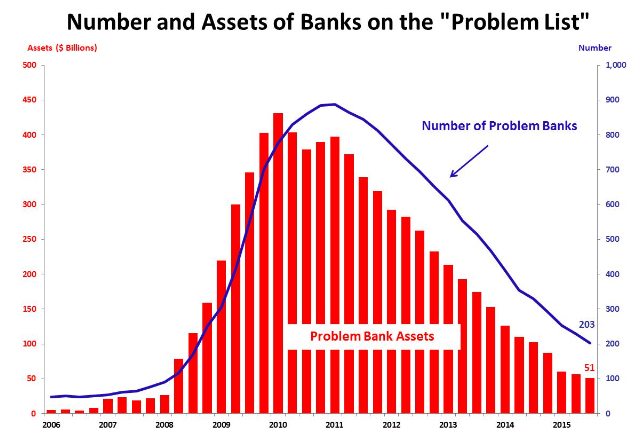
The FDIC expects fewer bank failures this year compared to 2011, but the fragile condition of the U.S.economy and the ongoing banking crisis in Europe could dramatically change things for the worse.  In addition, although the larger U.S. banks have stabilized considerably compared to their dire condition during the height of the banking crisis, the number of banks on the Problem Bank List remains elevated.  At the end of 2011 there were a total of 813 banks on the FDIC Problem Bank List, considerably higher than the total of 702 banks at the end of 2009.

The five failed banks closed this week by regulators had total assets of $1.42 billion and resulted in losses to the FDIC Deposit Insurance Fund of $272.6 million.

Listed below are the five bank failures for the week ending April 27, 2012.  Please click on the links for detailed information on each bank closing.

1.  Bank of the Eastern Shore, Maryland – Bank Failure #18

The failure of Bank of the Eastern Shore, although not the week’s largest bank failure, was the most important one from the standpoint of depositors.  Since the FDIC was unable to find a buyer for the Bank, depositors who had money in excess of the FDIC insurance limits face potential losses.  When a failed bank is purchased by another bank from the FDIC, the acquiring bank will normally assume all deposits of the failed bank, protecting depositors regardless of deposit size.

A typical depositor cannot realistically be expected to accurately assess the financial condition of a bank. Nor would anyone be able to predict if the FDIC would be unable to sell a failed bank.  It is therefore very important for bank depositors to ensure that all of their bank deposits are covered by FDIC insurance.  For information on this topic, see Is My Cash Safe In The Bank?

2.  HarVest Bank of Maryland, Maryland – Bank Failure #19

After no bank closing since November 2010, Maryland gets hit with two bank closings in one day.

3. Inter Savings Bank, Minnesota - Bank Failure #20

Inter Savings Bank was the third bank closing in Minnesota this year and the second largest bank failure this week as measured by total assets of $481.6 million.

4. Plantation Federal Bank, South Carolina - Bank Failure #21

With total assets of $486.4 million, Plantation Federal was the largest bank failure of the week.  Plantation Federal had been in business for over 17 years.

5. Palm Desert National Bank, CA – Bank Failure #22

Palm Desert National Bank, established in 1981, was the smallest bank failure of the week with total assets of $125.8 million.

]]>
0
Problem Bank List Staff http:// <![CDATA[Palm Desert National Bank, California, Closed By Regulators]]> http://problembanklist.com/?p=4797 2012-04-28T03:37:57Z 2012-04-28T03:37:57Z Palm Desert National Bank, Palm Desert, California, was closed today by the Office of the Comptroller of the Currency.  The FDIC, appointed as receiver, sold the failed bank to Pacific Premier Bank, Costa Mesa, CA., which will assume all deposits of Palm Desert National.

Established in 1981, Palm Desert was a relatively small bank with only one branch and approximately $125 million in assets.  The Bank was locally owned and operated.  According to the Bank’s website, Palm Desert offered a “superior level of personalized banking”, a full range of financial services and friendly service.

Palm Desert National will reopen on Monday as a branch of Pacific Premier Bank and all depositors of Palm Desert will automatically become depositors of Pacific Premier.  FDIC deposit insurance will continue on all accounts up to the applicable limits.  Over the weekend, customers of Palm Desert can access their money through the use of checking, ATMs and debit cards.

At December 31, 2011, Palm Desert had total assets of $125.8 million and total deposits of $122.8 million.  Pacific Premier agreed to purchase all of the assets of Palm Desert.

Pacific Premier is a very well managed and profitable bank with nine branch offices.  The bank was founded in 1983 and has almost $1 billion in total assets.  Prior to today’s acquisition of Palm Desert, Pacific Premier had acquired Canyon National Bank which failed in February 2011.  The holding company for Pacific Premier is Pacific Premier Bancorp which is a publicly traded company.

Courtesy: yahoo finance

The loss to the FDIC Deposit Insurance Fund for the failure of Palm Desert is estimated at $20.1 million.  Palm Desert is the nation’s 22nd banking failure of the year and the first in California since September 2011.

]]>
0
Problem Bank List Staff http:// <![CDATA[Plantation Federal Bank, Pawleys Island, South Carolina, Closed By Regulators]]> http://problembanklist.com/?p=4791 2012-04-28T03:05:11Z 2012-04-28T03:05:11Z Plantation Federal Bank, Pawleys Island, South Carolina, was closed today by the Office of the Comptroller of the Currency.  The FDIC, acting as receiver, sold the failed bank to First Federal Bank of Charleston, South Carolina.

Plantation Federal Bank, locally owned and operated, had been in business for over seventeen years.  The Bank prided itself on being a “community grown” financial institution, deeply involved in the local community.

At the time of its failure, Plantation Federal had expanded into a six branch bank with almost half a billion dollars in assets.  Plantation Federal Bank had been under regulatory scrutiny since 2010 when the Bank was issued a cease and desist order for operating in an “unsafe and unsound” manner.

The amount of defaulting loans at Plantation steadily increased each year since 2009.  As of the end of last year, Plantation Federal Bank had a ridiculously high troubled asset ratio of 463%.  Almost without exception, once a bank’s troubled asset ratio exceeds 100%, the bank winds up being closed by regulators.

All six branches of Plantation Bank will reopen on Monday as branches of First Federal Bank and all depositors of Plantation will automatically becomes depositors of First Federal Bank.  FDIC deposit insurance will continue uninterrupted up to the applicable limits.  Customers of Plantation Bank will have access to their money over the weekend through the use of checking, ATMs and debit cards.

At the end of last year, Plantation Federal Bank had total assets of $486.4 million and total deposits of $440.5 million.  First Federal Bank agreed to buy all of the assets of Plantation Bank.  Potential future losses on the asset pool acquired by First Federal will be shared with the FDIC subject to a loss-share transaction between the two parties which covers $221.7 million of the assets purchased.  The FDIC expects that losses on the failed Bank’s assets will be minimized by keeping the loans in the private sector and minimizing disruption to loan customers.

First Federal Bank is owned by holding company First Financial Holdings, Inc. (FFCH), the third largest financial institution in South Carolina based on total assets of over $3.2 billion.  The value of First Financial Holdings common stock has more than doubled since late last year.

Courtesy: yahoo finance

The estimated loss to the FDIC Deposit Insurance Fund for the failure of Plantation Federal is $76.0 million.   Plantation Federal Bank is the nation’s 21st banking failure of the year and the first in South Carolina since July 2011.

]]>
0
Problem Bank List Staff http:// <![CDATA[Inter Savings Bank of Minnesota (D/B/A Interbank) Closed By Regulators]]> http://problembanklist.com/?p=4786 2012-04-28T02:06:50Z 2012-04-28T02:06:50Z Inter Savings Bank, Maple Grove, Minnesota, was closed today by the Office of the Comptroller of the Currency which appointed the FDIC as receiver.   The FDIC sold the failed bank to Great Southern Bank, Reeds Spring, Missouri, which will assume all deposits of failed Inter Savings Bank.

Inter Savings Bank, (fsb D/B/A Interbank) which had been in business since 1965, was a relatively large bank with almost half a billion dollars in total assets.  Originally founded as Falls Federal Savings and Loan, the Bank expanded its operations to include branch offices in Florida. The Bank was purchased by a group of investors in the early 1990′s and the name was changed to InterBank.  Over its 30 years of operations, InterBank became one of the largest community banks in Minnesota with over $500 million in assets.

Unfortunately many of the assets held by Inter Savings Bank consisted of defaulted loans.  The Bank had a very high troubled asset ratio of 244%.  Typically, a bank with a troubled asset ratio in excess of 100% almost always winds up as a failed bank.

All four branches of Inter Savings will reopen on Monday as branches of Great Southern Bank and FDIC deposit insurance will continue up to the applicable limits.  Over the weekend, depositors of Inter Savings will have access to their money through the use of checking, ATMs and debit cards.

At December 31, 2011, Inter Savings had total assets of $481.6 million and total deposits of $473.0 million.  Great Southern Bank agreed to purchase virtually all of the assets of failed Inter Savings, subject to a loss-share transaction with the FDIC which will limit the losses to Great Southern on the asset pool purchased. The loss-share transaction between the FDIC and Great Southern will cover $413 million of the asset pool acquired.

Great Southern Bank, founded in 1923, is profitable and has over $3.8 billion in assets.  The holding company for Great Southern is Great Southern Bancorp, Inc. which is a publicly traded company.  The Bank pays over a 3% dividend yield and its stock price has recovered to levels seen before the economic crash of 2008.  Great Southern Bank had previously purchased two other failed banks during 2009.

Courtesy: yahoo finance

The FDIC defends the use of loss-share transactions as a means of maximizing returns on failed bank assets by keeping them in the private sector.  In addition, absorbing a portion of the losses on failed bank assets is a big incentive to attract purchasers of failed banks.  If the FDIC cannot find a buyer for a failed bank, losses are usually greater and depositors with balances in excess of insurance deposit limits are subject to losses on their savings.  This situation happened today when the FDIC was not able to find a buyer for the failed Bank of the Eastern Shore in Maryland.

The estimated loss to the FDIC Deposit Insurance Fund is $117.5 million.  InterBank becomes the nation’s 20th banking failure of the year and the third in Minnesota.

]]>
0
Problem Bank List Staff http:// <![CDATA[HarVest Bank of Maryland Collapses – Sold To Sonabank of Virginia]]> http://problembanklist.com/?p=4779 2012-04-28T01:20:05Z 2012-04-28T01:20:05Z The State of Maryland, which has not had a banking failure since November 2010, saw two banks collapse today as regulators closed the HarVest Bank of Maryland and the Bank of the Eastern Shore.  Since the start of the banking crisis in 2008, Maryland has had a total of only 8 banking failures compared to a nationwide total of 435 bank failures.

After state regulators closed the HarVest Bank of Maryland, Gaithersburg, MD, the FDIC was appointed as receiver and sold the failed bank to Sonabank, McLean, Virginia, which will protect depositors by assuming all deposits of failed HarVest Bank.

HarVest Bank, formed in 2003, was locally owned and operated.  Bank management had predicted that HarVest Bank would become the region’s “first choice for all banking needs” based on the Bank’s commitment to personalized service and an understanding of local customers that big banks in the area did not possess.  Unfortunately, a banking crisis, collapsing real estate values and the inability of small banks to raise capital all combined to lead to the Bank’s failure.

All four branches of HarVest Bank will reopen as branches of Sonabank and FDIC deposit insurance will continue up to the applicable limits.  Customers of failed HarVest Bank have access to their money over the weekend through the use of checking, ATMs and debit cards.

At December 31, 2011, HarVest Bank of Maryland had total assets of $164.3 million and total deposits of $145.5 million.  Sonabank, in addition to assuming all deposits of HarVest Bank, also agreed to purchase all assets of the failed bank.

Sonabank is owned by holding company Southern National Bancorp of Virginia, Inc, a publicly traded company.  Sonabank was opened in 2003 and is a full service community bank with over $600 million in assets.  Southern National Bancorp has been profitable for the past two years although its stock price is still below values seen prior to the banking crisis.

Courtesy: yahoo finance

The cost to the FDIC Deposit Insurance Fund for the failure of HarVest Bank is $17.2 million.  HarVest Bank becomes the nation’s 19th banking failure of 2012 and the second in Maryland.

]]>
0
Problem Bank List Staff http:// <![CDATA[Bank of the Eastern Shore, Cambridge, MD, Fails – Uninsured Depositors Out Of Luck As FDIC Fails To Find Buyer]]> http://problembanklist.com/?p=4772 2012-04-28T00:23:14Z 2012-04-28T00:23:14Z Maryland state regulators closed the Bank of the Eastern Shore, Cambridge, MD and the FDIC was appointed as receiver.  As has happened on previous occasions, the FDIC was unable to find a buyer for the failed bank, leaving uninsured depositors at risk of loss on their savings.

To protect insured depositors and wind down the operations of failed Bank of the Eastern Shore, the FDIC set up the Deposit Insurance National Bank of Eastern Shore (DINB) which will remain open until May 25, 2012.  Only insured deposits of Bank of the Eastern Shore were transferred to the DINB.  Depositors with insured savings will have until May 25th to transfer their accounts to a new institution.  The FDIC will mail checks directly to depositors with certificates of deposit and individual retirement accounts.

The FDIC currently insures deposits up to a limit of $250,000.  The FDIC will review all interest bearing accounts with balances in excess of $250,000 to determine if they are covered by deposit insurance.  Depositors with account balances over the deposit insurance limit of $250,000 should call the FDIC Call Center at 1-800-591-2817 to obtain a claims form for uninsured deposits.  Any depositor who winds up having uninsured money at the Bank of the Eastern Shore will receive a Receiver Certificate from the FDIC which entitles the holder to claim, at some future time, a proportionate share of the funds recovered from the disposal of the failed Bank’s assets.

The FDIC was unable to determine the amount of uninsured deposits at the time of the Bank of the Eastern Shore’s closing.  Depositors can assess their situation regarding possible losses on uninsured deposits by reviewing the FDIC’s web page “Is My Account Fully Insured?“.

A large number of banks remain in weak financial condition four years after the banking crisis started in 2008.  The FDIC Problem Bank List at December 31, 2011 totaled 813 banks or over 11% of all FDIC insured institutions.  Depositors need to be proactive in assessing the financial condition of the bank they keep their money at to avoid the horrendous situation of possibly losing part of their savings.

Alert depositors may have noticed that the Bank of the Eastern Shore received a Prompt Corrective Action (PCA) notice from the Federal Reserve in April 2011.  A PCA notice is usually issued when a bank is in dire financial condition and a strong message to depositors that they should move their money into a safer bank.

Ironically, some depositors with savings in excess of $250,000 will not lose a dime.  The Dodd-Frank Act provides for unlimited deposit insurance (through December 31, 2012) on non-interest bearing transaction accounts, regardless of account balance or type of ownership.  With the U.S. financial system still in fragile condition and the European banking system careening towards a full blown crisis, large depositors have been flooding U.S. banks with money that has been placed in non-interest bearing accounts (see $1.2 Trillion of Nervous Money Floods Into U.S. Banking System).

Large depositors who are nervous about the financial condition of their bank should consider opening multiple accounts at different banks to have full FDIC insurance coverage or consider putting their money into non-interest bearing transaction accounts, especially after considering the fact that the amount of interest paid by banks on short term savings accounts is almost at zero.

All branches and the main office of Bank of the Eastern Shore will reopen on Monday, April 30, 2012. Customers can continue to use checks, ATMs and debit cards until May 14th.

At December 31, 2011, the Bank of the Eastern Shore had total assets of $166.7 million and total deposits of $154.5 million.  Bank of the Easter Shore had been in business since 1986 and was a locally owned and operated state chartered bank.

The FDIC will retain all of the assets of failed Bank of the Eastern Shore for later disposition.  These junk assets are classified by the FDIC as “resolution receivables” and the pile of junk loans at the FDIC has become immense.  At December 31, 2011, the FDIC was holding $28.5 billion of “resolution receivables” -  junk assets from failed banks that they have not been able to dispose of (see The FDIC Has A $30 Billion Junk Loan Problem).

The cost to the FDIC fund for the failure of Bank of the Eastern Shore is $41.8 million.  Eastern Shore is the nation’s 18th banking failure of the year and the first in Maryland since November 2010.

]]>
0